The World I Discovered in Information and Mathematical Sciences as a Liberal Arts Student
“At the core of programming is communication between people,” says Kazuma Hayashida. Through activities such as table tennis, rugby, dance, and programming, he has broadened his interests and experience by engaging with a wide range of worlds. Coming from a liberal arts background, he advanced to the Faculty of Mathematical Informatics, starting from the fundamentals of mathematics for science and engineering. Through programming, he also took on collaborative projects with peers, gradually realizing the meaning of creating things together and the depth of learning involved. Here, we introduce the student life of Mr. Hayashida, who is steadily expanding his own potential step by step through his studies and club activities.
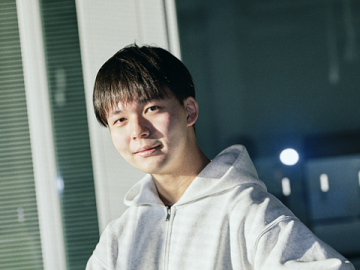
Kazuma Hayashida
Second-year student, Department of Mathematical Informatics, Faculty of Mathematical Informatics
Originally from Tokyo. He serves as head of the programming division in the information science club “Tetra,” while also being active as a dancer in the dance club “Break Jam.” His favorite music genre is K-POP, and he is a fan of ITZY from JYP Entertainment. One of his hobbies is oshi-katsu—supporting his favorite artists—such as going to live concerts and buying merchandise in Shin-Okubo. His favorite phrase is “steady progress, day by day.”
Dance, Table Tennis, Rugby—and Programming
Looking back, I’ve enjoyed being active and spending time outdoors since I was little. I devoted myself to club activities, joining the table tennis team in junior high and the rugby team in high school. After becoming a university student, I resumed dancing, which I had learned in elementary school. At the same time, I began working seriously on programming. When I look back now, I realize I’ve truly challenged myself across a wide range of fields. It wasn’t any special trigger that led me to these pursuits, but once something catches my attention and sparks my interest, I think it’s simply my nature to become deeply absorbed in it.

Searching for My Own Way of Learning, Centered on Mathematics
I was aiming for a liberal arts education when I first started thinking about where to go to university, but because I was good at mathematics, I wanted to study economics or business, so I initially focused on applying to those departments at other universities where I could make use of my math skills. But during my third year of high school, when it was time to decide on my future path, I heard from a family member that Meiji Gakuin University was establishing a new Faculty of Mathematical Informatics, and it unexpectedly became one of my prospective choices. As I researched further, I learned that the Faculty of Mathematical Informatics offered a curriculum that allowed students to build on their favorite subject, mathematics, while also engaging in programming and web page creation, which I was already interested in. It felt like a perfect match with what I had originally wanted to study at university.
Moreover, I found it appealing that although the faculty is classified as a science faculty, in addition to mathematics the entrance exam focused on English and Japanese—subjects typically associated with the liberal arts track. That realization made me feel as though my options had suddenly opened up. With that encouragement, I was ultimately accepted, and I enrolled without hesitation.
An Environment That Makes It Easy to Ask Questions Supports Learning
One of the first things I noticed after enrolling was that, coming from a liberal arts background, there was inevitably a gap between myself and students from science backgrounds in terms of understanding mathematics and other science-related subjects. I was good at mathematics, but I was encountering a lot of material for the first time, unlike students who had taken Math III in high school, and I struggled to keep up in class, sometimes feeling anxious or inferior.
At the time, I was taking Professor Kazuhiro Sakai’s Exercises in Basic Mathematics, which covered fundamental topics in mathematics for science, like vectors and matrices. I had difficulty keeping up with the content at first, but Professor Sakai carefully broke things down and taught in a way that was easy to understand even for students from liberal arts backgrounds. When I went to ask questions after class, he responded thoughtfully to even my smallest doubts, and that support truly helped me get through. Studying on my own was, of course, also essential, but there is no doubt that being able to solidify my foundations while continuing to study in a science faculty was made possible thanks to the attentive follow-up provided by Professor Sakai and the other Mathematical Informatics faculty members. Because it is a small faculty, students and professors can work closely, and I am sincerely grateful for the support this learning environment provides.

Implementing Ideas on Campus
The club I belong to, “Tetra,” is a group where students are free to launch their own projects and work on activities such as programming, image and video editing, and game development. We began operating in earnest last September, and this year we have also introduced a divisional structure, with programming and graphics divisions.
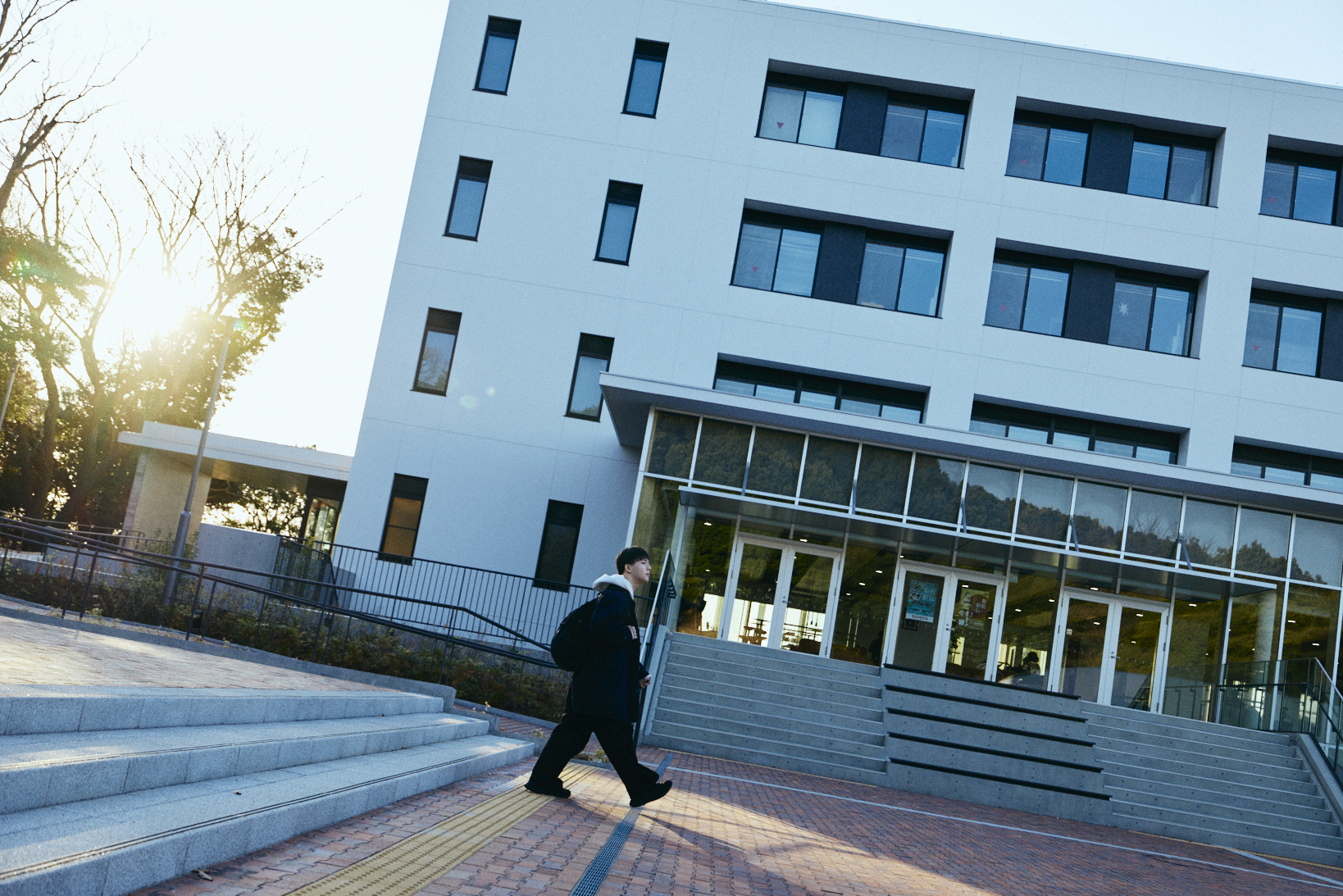
At present, our main focus is on developing an information display for the digital signage installed in Building 11 on the Yokohama Campus. The display compiles, on a single screen, weather, time, Enoden bus service information, and other information useful for students who commute to the Yokohama Campus. We are developing it through programming in close collaboration.
Connecting with People Through Writing Code
I think that when many people think of programming, they imagine someone sitting alone at a computer, with technical terms and symbols filling the screen, endlessly writing code. While that aspect certainly exists, programming is fundamentally a means of answering needs: solving a problem someone has or providing convenient functionality. For that reason, while honing programming skills is important, I feel that in human communication, having an attitude of empathizing with others’ feelings and understanding the issues they face is just as important.
In addition, project development is rarely completed by a single person. In our information display project, for example, one member writes code to retrieve weather data, another handles the program that processes bus operation information, and yet another comes up with page design ideas. Each member contributes through their own area of responsibility as we move the project forward together. By coordinating with one another and steadily building up deliverables, everything gradually takes shape into a single finished product. Throughout that process, discussions aimed at improving the result are indispensable, and they reinforce my sense that, at its core, programming is indeed about interpersonal communication.

Delving Deeper and Becoming More Practical with Programming
As for my future, I am currently considering two main paths. One is to go on to graduate school and pursue more specialized research in programming. The other is to join a company and put my programming skills into practice as my profession.
Personally, mathematical informatics is the field I always wanted to study. After entering university and encountering the depth of programming and mathematical ways of thinking, my desire to dig deeper has only grown stronger. I thus find the graduate school environment, one where I can identify my own research theme and devote myself to it over time, extremely appealing.
Then again, the option of working in industry also interests me. I have seen code I wrote actually run and become something useful to others, and that makes me want to start applying my skills in society as soon as possible. Both paths are attractive, and honestly, I am still undecided. In the end, I want to choose a path I can be satisfied with, while staying true to what I love.
My Message to Prospective Students
I greatly value the phrase nisshin geppo—“steady progress, day by day.” When I had just entered university, there were times when I felt discouraged, thinking that everyone else could do things I alone could not. This phrase helped me come to think, “If I’ve advanced even one millimeter compared to yesterday, that’s enough.” Looking back now, I feel that mathematics and programming are built precisely through such small, steady accumulations.
In that sense, I want to tell prospective students, even those from a liberal arts background, to definitely give us a try. I’ve seen for myself how Meiji Gakuin’s Faculty of Mathematical Informatics provides an environment where you can steadily advance your learning, even if you’re starting from zero. As you work step by step at your own pace, there will surely come moments when you can feel how you’ve grown compared to yesterday.