Department of International Studies
Department of International Studies
Department of Global and Transcultural Studies

Becoming citizens who think for ourselves and take collaborative action in a globalizing world
In contemporary society, events occurring on the other side of the globe can have an immediate impact on our lives. We are also expected to work with people of diverse origins and cultural backgrounds. Students in the Department of International Studies explore various multicultural, environmental, and peace-related issues confronting our society with faculty members who are experts in fields related to culture, economics, politics, law, and society in various regions around the world. Through small-group exercises and hands-on learning, our students develop the ability to think flexibly from multiple perspectives, along with communication skills to hold logical discussions.
Department of International Studies
Key Features of the Department of International Studies
Program Structure
Topics
Admission Policy
Key Features of the Department of International Studies
Point 01
Small-group classes
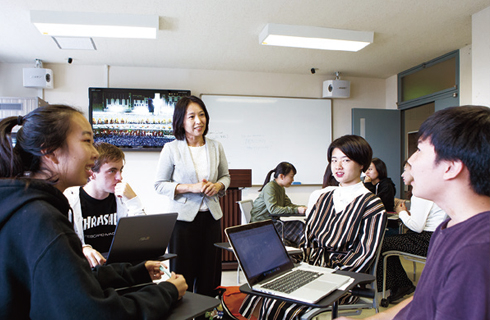
In each year of their course, students learn about international studies in small-group exercises (seminars) of around 12 people. They acquire critical thinking and communication skills in learning communities where they can hold discussions in an atmosphere of mutual trust. In their final year, students write a graduation thesis as the culmination of their learning and experience, supporting one another through peer feedback and advice.
Point 02
Interdisciplinary learning
Students learn about global issues from diverse fields related to culture, economics, and politics. In their first year, they cover a wide range of basic topics, during which time they can tailor their curriculum according to their own interests. A combined approach is also possible, such as considering regional development from the perspective of multicultural coexistence, or studying environmental protection from the perspective of legal systems. Regional research focusing on various parts of the world is another distinctive feature of the learning we offer.
Point 03
Practical English education
We offer a specialized foreign language program in which English is studied up until the third year. Students are divided into small-group classes according to their level of ability, and study topics related to their specialization in English. In addition to developing the four core language skills—reading, writing, listening, and speaking—students gain academic competencies such as logical thinking, presenting, and debating in English.
Point 04
A global environment
The Department supports various opportunities to study abroad and a range of overseas internships. For example, in addition to the double degree program whereby students can earn degrees from both San Francisco State University and Meiji Gakuin University, we offer programs to study abroad in various parts of the world and an internship program where students can learn the local language and culture while playing a role in the Japanese language education provided in Australian schools. Furthermore, the Yokohama Campus allows our students to spend four years in a multicultural environment as it attracts young people from all over the world.
Program Structure
As of the 2027 academic year, the department will have a new curriculum that further enhances interdisciplinary learning. Students start to build the foundations for their interdisciplinary learning in their first year via small-group learning (Introductory Seminar) and basic specialized classes with a focus on four areas: peace, impartiality, and diversity; language and culture; the global economy; and regional communities and the environment. From their second year onwards, students select seminars according to their interests, determining the core elements of their studies. They study their specializations in greater depth in their third and fourth years, and the culmination of their studies is the graduation thesis they write in their fourth year.
Topics
Principles of Environmental Studies
- Learning that incorporates discussion and puts students in touch with nature
Environmental destruction has become a serious issue as a result of profit maximization becoming the main objective of economic activities. In this course, students consider and discuss themes such as agriculture, food, and ecosystems by drawing upon their interactions with crops, vegetation, bees and other aspects of the natural world in Maioka Park, which adjoins the Yokohama Campus, and with the natural environment on campus. The course also includes time set aside for philosophical discussions.
Peace Studies 1
- An academic discipline intended to put an end globally to all forms of violence
Foundations of Peace Studies 1 explores the nature of violence, which it defines as ”anything that makes someone feel they cannot go on living,” ranging from war to poverty and discrimination. Students think in practical terms about the root causes of violence, why we need to be concerned about the violence that others are suffering, and above all, how violence can be eradicated.
For example, in contrast to the idea of strengthening the security of a country via the possession of nuclear weapons, students consider ways to strengthen the long-term security of a country without possessing nuclear arms. They also consider bullying, not as an issue between the bully and the bullied, but as a systemic issue that involves people who disregard bullying and also the schools or other locations where bullying occurs.