Mathematics Protecting Our Digital Lives—What Does a “Do for Others” Technology Look Like from a Cryptographic Theory perspective?
Shopping online with a smartphone. Signing digitally with a My Number Card. Behind such everyday actions, performed without a second thought, a sophisticated branch of mathematics works quietly yet with absolute certainty. That branch is “cryptographic theory,” the specialty of Professor Anada. As the security of information and communications grows ever more critical at every level, from individual lives to national security, Professor Anada is advancing research into new cryptographic methods that protect privacy while also applying the university’s educational philosophy of “Do for Others” to mathematical informatics education.


Hiroaki Anada
Professor, Department of Mathematical Informatics Faculty of Mathematical Informatics
Completed the doctoral degree in Information Security, Graduate School of Information Security, Institute of Information Security. Ph.D in Informatics. While working as a research and development engineer at NEC Corporation, he pursued specialized research in cryptographic theory during his doctoral studies. After serving as Professor in Faculty of Information Systems at University of Nagasaki and Professor in Faculty of Software and Information Technology at Aomori University, he assumed his current position in April 2024.
A History of Cryptography Stretching Back to Ancient Times
My field of specialization is computer science, and I currently conduct research in one of its branches: cryptographic theory.
The history of cryptography is long. Julius Caesar, the ancient Roman general, is said to have used the “Caesar cipher,” which shifts each letter of the alphabet by a secret fixed number of positions. For roughly 2,000 years after that, cryptography was used primarily in military and diplomatic contexts.
The invention of “public-key cryptography” in the 1970s marked a turning point, bringing cryptographic theory into widespread use.
Public-key cryptography uses two keys: an encryption key and a decryption key. Only the encryption key is made public, while the decryption key is kept secret by the receiving party, thereby enabling secure communication. Unlike traditional modes of communication, the internet allows information to be exchanged with an unlimited number of unspecified parties, with a constant risk of interception by third parties. Technologies based on public-key cryptography made it possible to send and receive messages and data safely and securely, free from eavesdropping and tampering even in such a public environment.
Despite being a familiar technology widely used for online authentication and digital signatures, the design and analysis of cryptographic systems require deep mathematical thinking. Just a few lines of complex equations, the slightest degree of elegance or clumsiness in design, can decisively determine whether a cipher works or fails. That is the world of cryptographic theory. The research process involves repeatedly transforming equations to build up layer upon layer of logic, but each step is like walking a tightrope. Is this transformation truly correct? Have I overlooked something? Working through such questions again and again, the thrill of crossing that tightrope—a path as narrow as a single thread—is one of this field’s irresistible charms.
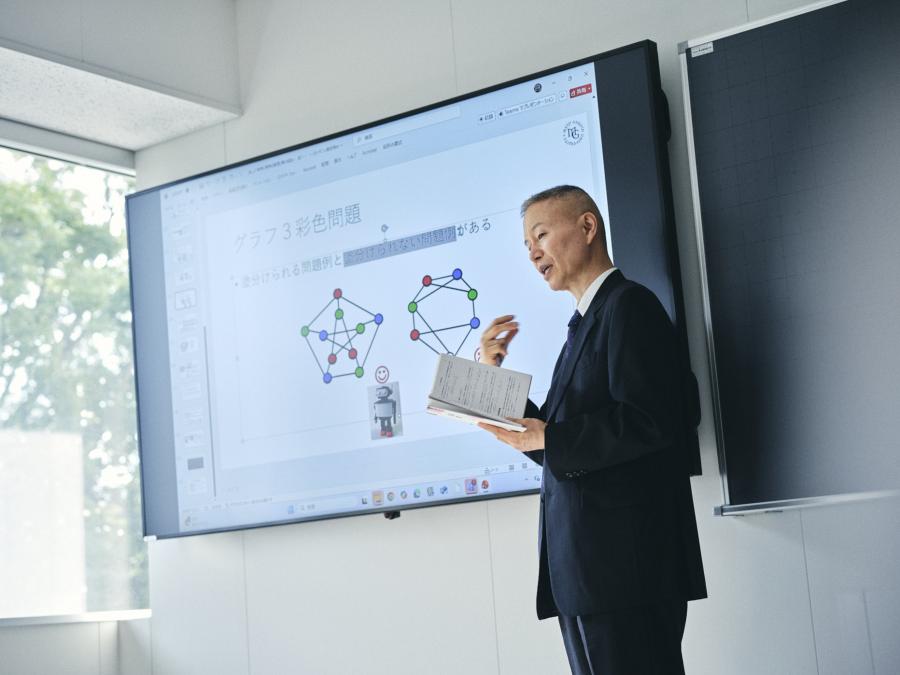
Take the internet, which we use every day, as an example. When exchanging messages, it is worth asking whether the person on the other end is really who we think they are. In that “identity verification” process, it would be perfectly satisfying to have the other person simply tell us a secret, something only they could know. But that is impossible. If the other party divulges that secret, we would then be in a position to impersonate them and cause trouble. The question for the other party, therefore, is how they can convince us without revealing their secret. The first equation in the figure below represents the design principle of convincing the other party that you genuinely know your secret. The second equation ensures the secret is never leaked to the other party. The art lies in precisely constructing a delicate mathematical design that achieves both of these seemingly contradictory properties.

Figure: Some of the equations used for identity verification on the internet.
Continuing along that “tightrope,” one comes to feel that what is visible is not all that matters. To quote from Antoine de Saint-Exupéry’s The Little Prince, “What is essential is invisible to the eye.” Just as love and conviction, both invisible yet essential, are fundamental to human beings, I believe mathematics, too, is one of those “invisible but essential things” that support people and society.
Achieving “Fairness” Between Anonymity and Traceability
What I am currently researching is the development of cryptographic algorithms that reconcile two seemingly contradictory properties in network-based services: “user anonymity” and “traceability by administrators.”
In services delivered over networks such as the internet, guaranteeing user anonymity is critical from a privacy protection standpoint. At the same time, anonymous harassment and defamation occur daily on social media platforms and have become a serious social problem. When a victim of harassment legally requests disclosure of the sender’s information, the platform operator must trace the sender’s history and data for identification. In other words, even in services that offer anonymity, the ability of administrators to monitor (traceability) is recognized by society as a necessary feature.
Yet that power to trace comes with a dangerous potential for abuse. The 2013 “Snowden affair” revealed that governments had obtained vast amounts of individuals’ supposedly encrypted communications, and speculation arose about the existence of “backdoor keys” capable of decrypting encrypted transmissions. What this exposed is the difficulty for users in knowing when platform operators are tracing their data without a legal basis, in other words, the reality that traceability has been weighted more heavily than anonymity. For this reason, I focus my research on cryptographic theory that reconciles both properties, with the question “How can anonymity and traceability be made fair?” as my theme.

Giving Power to Users: Toward a Fairer System
My recent research approaches the technology of “group signatures,” a form of anonymous digital signature. A group signature scheme uses public-key cryptography and similar techniques to prove that someone within a group has signed, without identifying which member it was.
Through this research, it has become possible to design a system in which, when generating a group signature, the signing member can specify who is permitted to open it. For example, suppose a department has three members, A, B, and C. Member B creates a digital signature on behalf of the group. If B specifies that “the manager or CEO may open it,” then the manager and CEO can learn that B signed it, while the factory manager and others can only know that someone in the group signed it. By giving users direct authority to choose who is permitted to access their information, this scheme should bring the balance toward a traceability that is closer to fairness.
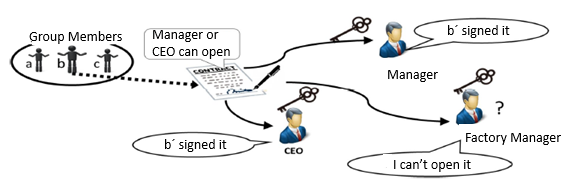
Figure: A group signature scheme in which signing members can specify who is permitted to open the signature.
However, this system actually presupposes that the administrator who issues the keys for opening signatures holds a “master key” capable of opening all group signatures. Having such all-powerful authority is undesirable from a privacy protection standpoint. For this reason, I continue to advance research toward a design that reconciles anonymity and traceability even in the absence of a master key.
Protecting anonymity, if such a mechanism can be built while enabling administrators to trace information openly and fairly with users’ understanding when necessary, I believe it will allow secure, trustworthy communication to be realized in a more equitable way. The goal of the research is still a long way off, but I am advancing one step at a time along this long path.
Why Mathematical Informatics Needs “Do for Others”
Our university is planning to establish a Graduate School of Mathematical Informatics (as of August 2026, the application for establishment approval is pending). In highly specialized fields such as research and development, many companies seek candidates with master’s-level knowledge and thinking skills. The establishment of the Graduate School of Mathematical Informatics will provide students with an environment in which to pursue highly specialized research and expand the range of career options available to them. Speaking recently with students’ parents and guarantors about learning at that graduate school, I told them, “We pursue truth.” When they hear talk of “pursuing truth in the field of mathematics,” students and parents may worry if that will lead to employment, if the students will be able to find a job. In response to such concerns, as I have described throughout this piece, our lives—surrounded by smartphones and the internet as they are—are sustained by truths scattered across the logical web of mathematics. The significance of mathematical truths grows with each passing era, and pursuing truths in quantum information, AI, information security through cryptographic theory, and other research domains of the Faculty of Mathematical Informatics is an endeavor that responds to society’s needs. Amid growing concerns that AI will take over human jobs, I want young people who worry about what kind of work they can do to study mathematical informatics, a field that underpins so many areas of society.
Alongside the pursuit of mathematical truth, there is something else we must consider: the fundamental question of what technology ought to be.
It has been nearly twenty years since Apple unveiled the first iPhone in 2007, and since then, smartphones have transformed the lives of people around the world. Today, even babies can swipe a screen. In another fifty years, people may no longer hold phones in their hands; instead, microcomputers and communication devices of various kinds may be embedded in the human body. By that time, the boundary between humans and AI will likely be far more blurred than it is today.

In the world of information and communications, there is a common expression: devices “hang” on a network. Just as automobiles already hang on the internet with their location data and driving data being collected, when the human body itself becomes part of the network, when human lives hang on a network, privacy protection will become a far more serious problem than it is today, beyond comparison. What form should the mechanisms that protect people take in a world where technology has developed to an advanced degree? How should those mechanisms be realized through the logical web of mathematics?
I believe the guiding principle for thinking through these questions is exactly this university’s educational philosophy: “Do for Others.” Precisely because we live in a technology-dominant age in which anyone can casually use generative AI, the attitude of seriously asking whether we’re really taking the right approach, and the ethical sensibility to back it up, is also growing in importance. That is the meaning behind a Faculty of Mathematical Informatics being born at Meiji Gakuin University, a university with a long history in the humanities and social sciences pursuing the question of what it means to be human.
A Fascination Accessible Only to Those Who Study Deeply
Cryptographic theory is a rewarding field of study that contributes to the world, but the true reason I pursue research in this area is quite simple: it is fascinating. The ideas of those who came before us are extraordinarily interesting. That said, their fascination is something you can only appreciate by thinking carefully and studying deeply. And the more difficult a subject becomes, the more its fascination can only be conveyed through face-to-face interaction, because there would otherwise be no opportunity to make the necessary time investment to think things through. What further distinguishes humans from other living creatures is that we pass on not only genes but also cultural assets. A university is a place for the transmission of cultural assets, where faculty and seniors convey those assets in person, and students and juniors take them in, then add their own ingenuity and creativity. I myself am driven every day by the feeling that I must pass on what I have inherited to my students. I sincerely hope you will pursue the truths of mathematical informatics here at our university and experience the depth and fascination of that world.